About
We hit this gap in our own work.
OPAL comes out of ATDev, Assistive Technology Development, a team that includes creators with significant motor disabilities and that builds in Unreal Engine 5 every day.
Assistive technology, built by the people who use it
ATDev builds assistive technology for real deployment, not demonstration. Our co-founder and Chief Marketing Officer, Owen Kent, who has used a power wheelchair his entire life, leads this initiative, and disabled creators shape the design and the testing. They don’t review it at the end.
That’s not a positioning statement. It is why the design rules on this site are specific: they come from people who have already tried to do this work through a single input channel and found out exactly where it breaks.
Owen has built this kind of thing before, on his own time. Nimbus Adaptive Controller is free, open-source software he wrote so that people who cannot use a conventional gamepad are not forced to buy expensive adaptive hardware in order to play or to work. It takes whatever input someone can already drive and turns it into a controller that games and ground-control software accept, and it has shipped eleven releases since November 2025. OPAL points the same instinct at a harder target: an editor, not a game.
Other work from this team
- RAMMSAn open-source, physics-driven digital twin of a robotic wheelchair, built in Unreal Engine 5.
- Omega StickAn open low-force joystick for computer control and gaming, sensed without contact and 3D printable. MIT-licensed firmware and published mechanical files.
- UEMCPThe MIT-licensed server that drives a live Unreal Editor by natural language, and the seed of OPAL.
- Alpha-OSKA free, MIT-licensed on-screen keyboard for Windows and Linux, with on-device word prediction and modifiers that can be locked held. Sixteen releases since April 2026. Also built and shipped by Owen Kent.
- Nimbus Adaptive ControllerFree, open-source software that stands in for adaptive controller hardware, so people can play and create with the input they already have. Built and shipped by Owen Kent, who leads OPAL.
- ReflexA telehealth-enabled robotic knee brace for at-home rehabilitation.
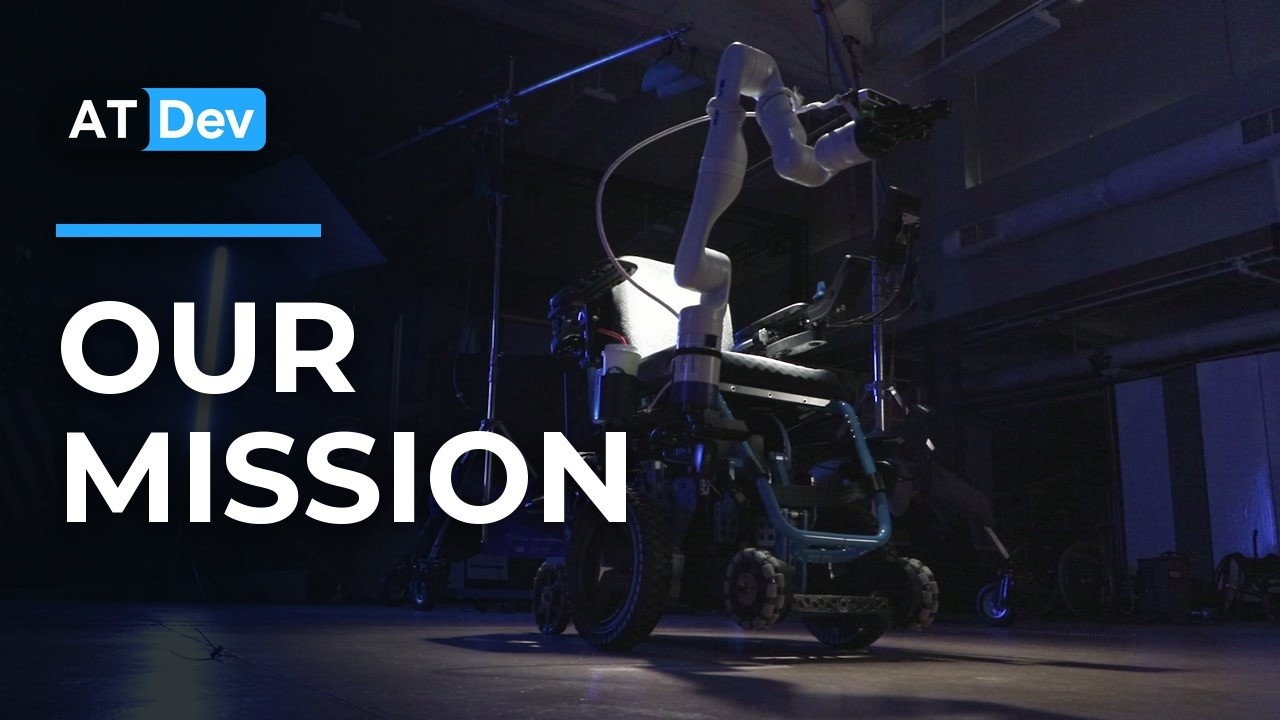
RAMMS, and how we found the wall
OPAL did not begin as a product idea. It began as an obstruction in an ordinary working week.
ATDev builds RAMMS inside RAMMP, the Robotic Assistive Mobility and Manipulation Platform, a $41M ARPA-H program to build the first open-source robotic wheelchair and assistive manipulation platform.
RAMMS is physics-driven end to end. The chair is rigid bodies under physical constraints, driven by simulated motors and actuators, with mass, friction and contact tuned to the real components, so it has to climb a curb under its own torque. Nothing plays back an animation. Component specs live as editable data, so changing a motor speed or swapping an actuator re-runs the physics without rebuilding the project. That is how we down-select real hardware before anything is fabricated.
Unreal also runs on the prototype. Our open-source RAMMP interface runs on an Nvidia Jetson and a touchscreen mounted to the chair, pulling live sensor data off it and rendering the world around it in 3D, the role Unreal already plays in automotive HMI. It runs the same stack and assets as the simulation, so the interface proven in the twin is the interface the rider gets. High-bandwidth sensor and camera streaming exceeded what Unreal’s remote execution plugin supports, so we wrote our own to carry it.
We are not visitors to this engine. Doing that work every week is how the editor gap stopped being abstract. The people building an open-source wheelchair couldn’t fully operate the tool they were building it in.
ARPA-H funds the simulation. It does not fund making the Unreal Editor operable by disabled creators, and nothing else does either.
So we stopped waiting for anyone to fund it and built the first piece ourselves. UEMCP exists because our own colleagues needed it in order to do their own jobs. It came out of our own work. There was no budget for it. It is MIT licensed and public, which is why the work ahead is finishing something, not starting it.
OPAL is scoped tightly to the editor layer for the same reason. It is the one piece that does not otherwise happen.
What we found when we went looking
In 2023 someone posted on Unreal’s forum that macOS Voice Control drove Blender perfectly well, then fell apart in the Unreal editor. It went essentially unanswered. That thread is still the closest thing to prior art we have found, and we went looking hard.
Every Unreal accessibility feature shipping today serves the player of a finished game. We are aware of no other project addressing accessibility of the editor itself.
If we have missed something, tell us. We would rather contribute to existing work than duplicate it.
Help us build it, or be one of the first to use it
Everything here is designed and tested with disabled people from the start, not validated at the end. If you work in Unreal with alternative input, or you want to, we want to hear how you work. If it is the stick you are waiting on, put your name down.